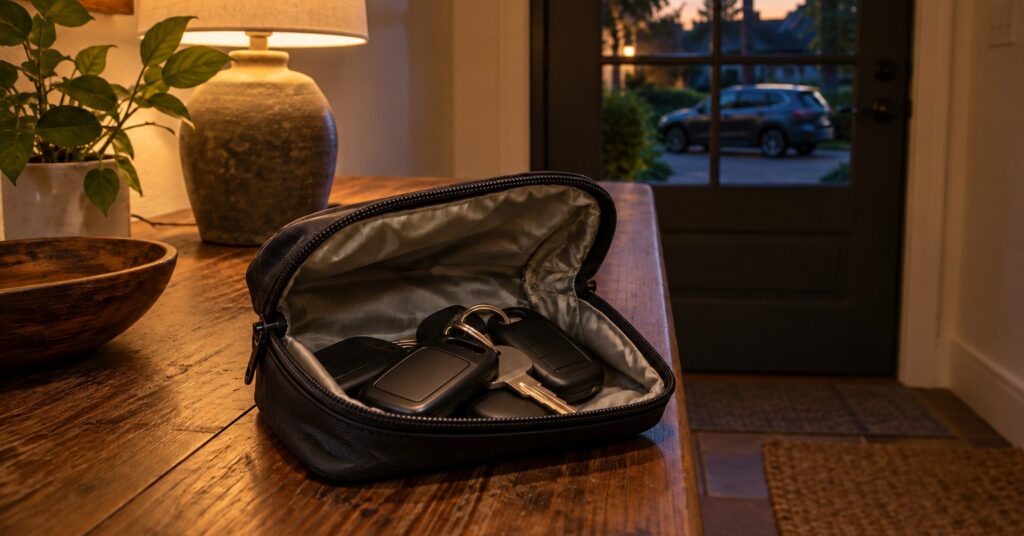
A keyless car unlocks when its key is close enough to answer a short-range radio signal.14 Thieves can carry that check from the car to a key that is still indoors, so the car behaves as if you were beside it.2 A Faraday pouch for car keys is a small signal-blocking pouch that keeps the fob from answering. You will be able to test one on your own driveway.
Last checked October 28, 2026.
Quick answer
- If you must press a button on the fob to unlock, police say you do not have the keyless feature this attack uses.1
- If the car unlocks as you walk up, store every fob, including the spare, in a signal-blocking pouch and test it.13
- With the key closed inside, the car should stay locked when you try the door.2
- Keep keys away from doors, and check whether the fob can switch off or sleep when it sits still.23
Why a keyless car key can be reached from indoors
Keyless entry lets you unlock and start the car without inserting a traditional key.4 Thatcham Research describes the car as broadcasting a radio signal at a range of two metres around the vehicle. If the fob is in range it replies, the door can unlock, and once you are inside the fob does not have to be inserted anywhere to start the car.4
A relay is a pair of radios that pass those messages along. Warwickshire Police describes one person near the house, picking up the fob, and another beside the car, unlocking it.2 UK police call this relay theft: a device fools the car into treating the key as nearby, which can unlock the car and start the ignition.1 Police say thieves only need to be within a few metres of the key, even indoors.1 Thatcham’s account says the device by the house can send the car’s signal up to 10 to 15 metres indoors, and that a second relay is required to start the ignition.4
In a paper presented on 7 February 2011, researchers at ETH Zurich showed that forwarding the messages worked even when encryption was used.7 Encryption scrambles a message so outsiders cannot read it. The relay did not need to interpret that message: the paper says no interpretation or manipulation of the data is needed.7 In that study the key and the car stayed up to 50 metres apart, and some keys could be woken from up to 8 metres.7
Your options: four ways to keep the key quiet
Maps, the key and a camera sit together in a quieter car: map, key and camera.
1. A signal-blocking pouch
Police.uk advises a signal-blocking pouch, such as a Faraday bag, checked every few months.1 Warwickshire Police says these pouches have a metal lining that blocks the key’s signal.2 Researchers at ETH Zurich described a metal-lined case as a Faraday cage around the key. They said that shield would make a relay very difficult in practice, while a stronger signal might still get through a weak one.7 In November 2024, Drive reported that all three pouches it bought stopped its four test cars opening while the key was inside. Drive said one product did not block the signal when the flap was remotely open.8 Thatcham says to test a pouch yourself, and to put the spare in one too.43
Pros
- It covers the fob you carry and the spare.
Cons
- It has to be fully closed,8 and it does not stop someone hooking the key out through a letterbox.1
- Many shields are made for credit cards. Thatcham warns that the pouch must still shut with the keys inside.6
2. A metal box you already own
Warwickshire Police says a metal box, such as a biscuit tin, may also work, if you check it first, and that a metal-lined pouch is more reliable.2
Pros
- You can try it the same day.
Cons
- If the door still opens, that box is not working for that key.
3. Switch the fob off, or use a fob that sleeps
Police.uk says to turn the fob’s wireless signals off when you are not using it.1 Thatcham says to read the manual for a night switch, and to ask the dealer about a motion-sensor fob.3 In sleep mode the sensor notices the key has not moved, the fob stops answering relay attempts, and it works again when you move the key.5 In 2019 Thatcham said some fobs sleep in one or two minutes and others take 15 or even 30.5 If a motion-sensor fob is not available, Thatcham says to consider a tested pouch, check whether the fob can be switched off, and store every fob away from household entry points.5
Pros
- An off or sleeping fob stops answering a relay.
Cons
- Not every key has it. On an older car, ask whether an updated fob exists.2
4. Distance, a locked car, and a physical lock
Police say to keep every key away from the car, the front door and the windows.12 Distance does not switch the fob off. A pouch does not stop other kinds of theft. Jammers can block the lock signal as you walk away, so check that the car has actually locked.1 Police.uk also points to steering-wheel locks, pedal boxes and gear-stick locks tested by Sold Secure, which can still help if a thief gets in.1 Thatcham suggests a wheel lock or a gear clamp as a visible deterrent.3
Pros
- These steps cover thefts that never use the radio from your key.
Cons
- None of these steps silence a fob that is still answering from the hall.
Use them with the pouch. A phone account on the car is a separate question, covered in skipping the car’s connected account. Footage is separate again: see a camera that keeps the video on a card.
How to test and use a pouch
Do this with the key you carry, then with the spare.
- Confirm you have keyless entry. If the car unlocks only when you press a button, police say this relay is not the risk.2
- Read the manual for an off switch or a sleep mode, and note how long the fob stays awake.5
- Choose a pouch that closes around the whole fob. Many pouches are made for credit cards, so check that the keys do not hold the mouth open.6
- Move every other key out of range. The car unlocks when a valid fob is close.1
- Try the locked door. With the key in the pouch, walk up. The car should stay locked.2
- Take the key out and try again. The car should unlock. Then seal the pouch and confirm the door stays shut.
- Store both fobs away from doors, windows and the letterbox.12
- Repeat the test every few months.1 When you park, check that the car has locked.1
Common mistakes to avoid
- Skipping the driveway test and trusting the packet.4
- Using a credit-card sleeve that cannot close over the fob.6
- Pouching one key and leaving the spare by the door.3
- Leaving the flap open, or testing while another fob is still near the car.81
- Expecting the pouch to stop a letterbox theft, a lock jammer, or a tow.1
Frequently asked questions
Do Faraday pouches stop keyless car theft?
They are meant to stop the relay, which needs the fob to answer. Police and Thatcham both recommend a tested pouch, and the ETH Zurich researchers found a weak shield may not hold if the attacker raises the reading power.147
How do I test a Faraday pouch for a car key?
Close the fob inside, keep any spare far away, and walk up to the car. If the door unlocks, that pouch is not working for that key.2 Repeat every few months.1
Does a biscuit tin work as well as a pouch?
Warwickshire Police says a metal box such as a biscuit tin may work, if you test it, and that a metal-lined pouch is more reliable.2
What if the key already goes to sleep?
A sleeping fob should ignore relay signals until you move it.5 Thatcham has reported delays from a minute or two up to half an hour, so time yours before you rely on sleep alone.5
Sources
- Police.uk: Preventing car and vehicle theft
- Warwickshire Police: Keyless vehicle theft
- Thatcham Research: How can you increase your car security?
- Thatcham Research: What is keyless entry / start?
- Thatcham Research: Carmakers introduce sleeping fobs to frustrate keyless thieves
- Thatcham Research: Five of the 11 new cars launched in 2019 rated Poor for security
- NDSS Symposium: Relay Attacks on Passive Keyless Entry and Start Systems in Modern Cars (7 February 2011)
- Drive: Do Faraday bags for your car keys actually work?